
J.K. Rowling and the Extraordinary Life
by Claire E. White
When one reads about Joanne Kathleen Rowling in the mainstream press, one generally is bombarded by a barrage of numbers: the millions of
|
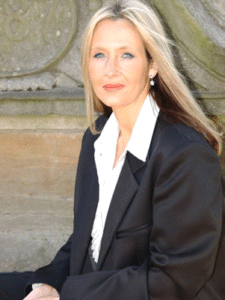
J.K. Rowling has been ranked as #40 on Forbes' list of the 100 most powerful women in the world. She is the first author in history to be worth $1 billion, and is only one of five women who are self-made billionaires. She has accomplished the nearly unthinkable for a modern writer: she has achieved overwhelming critical and financial success in her own lifetime. Forbes classifies her as a "media dynamo," which from all accounts is somewhat amazing to the modest British girl whose greatest dream was to see one of her books for sale in a bookshop and -- if fortune smiled upon her -- to have a positive book review in a national newspaper. Forbes says:
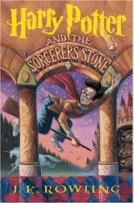
"Her Harry Potter books have sold a stunning 270 million copies in 62 languages worldwide. Her sixth installment of the Harry Potter blockbuster series, Harry Potter and the Half-Blood Prince, sold a breathtaking 6.9 million copies in its first 24 hours of release and is the largest-ever product debut on Amazon.com. Generating more than $100 million in revenue, her new book's debut is not only the richest opening in publishing history but also gave heart palpitations to the makers of the movie Charlie and the Chocolate Factory, which debuted the same weekend as the new book. This seven-year phenomenon is not letting up anytime soon, though Rowling has said the seventh installment will be her last. Harry Potter movies, with their antic capers of magic and wizardry at the Hogwarts School of Witchcraft and Wizardry, have grossed an impressive $2.5 billion to date, including DVDs." 1She has also collected the unwanted trappings of celebrity: reporters used to pound on her front door while she was making dinner (until she moved into a more security-conscious home), rumors about her life appear regularly in the newspapers and on the Internet (which she gleefully and regularly rebuts personally on her website), and she is recognized on the street by fans. She has also earned what is undoubtedly the most unwanted badge of celebrity of all: grainy photographs of her in a bikini while she was on her honeymoon with Dr. Neil Murray appeared in the British tabloids.
|
"After leaving university I worked in London; my longest job was with Amnesty International, the organisation that campaigns against human rights abuses all over the world. But in 1990, my then boyfriend and I decided to move up to Manchester together. It was after a weekend's flat-hunting, when I was traveling back to London on my own on a crowded train, that the idea for Harry Potter simply fell into my head."
"I had been writing almost continuously since the age of six but I had never been so excited about an idea before. To my immense frustration, I didn't have a functioning pen with me, and I was too shy to ask anybody if I could borrow one. I think, now, that this was probably a good thing, because I simply sat and thought, for four (delayed train) hours, and all the details bubbled up in my brain, and this scrawny, black-haired, bespectacled boy who didn't know he was a wizard became more and more real to me. I think that perhaps if I had had to slow down the ideas so that I could capture them on paper I might have stifled some of them (although sometimes I do wonder, idly, how much of what I imagined on that journey I had forgotten by the time I actually got my hands on a pen)."
"I began to write Philosopher's Stone that very evening, although those first few pages bear no resemblance at all to anything in the finished book. I moved up to Manchester, taking the swelling manuscript with me, which was now growing in all sorts of strange directions, and including ideas for the rest of Harry's career at Hogwarts, not just his first year. Then, on December 30th 1990, something happened that changed both my world and Harry's forever: my mother died." 2
|
"I saw her for the last time just before Christmas 1990. She was extremely thin and looked exhausted. I don't know how I didn't realize how ill she was, except that I had watched her deteriorate for so long that the change, at the time, didn't seem so dramatic. I said goodbye to her and left to spend Christmas with my then boyfriend's parents, the first time I had spent it away from her."Less was known about multiple sclerosis when her mother suffered from it, although Scotland has the highest incidence of MS in the world. Rowling's impassioned essay about the appalling lack of government funding to help people with the disease caused a furor in Scotland. Rowling marched on Scottish Parliament to raise awareness of the cause, which led to massive reform in the way the disease is treated. She is the patron of the Multiple Sclerosis Society of Scotland and has given generously of her time and money to the cause that means so much to her.
"She died on New Year's Eve. When the telephone rang at half past seven in the morning and my boyfriend's mother called up the stairs, "It's your Dad," I knew. Fathers don't call their daughters that early except for the worst of reasons. She was 45 and I still can't write about her without crying."
"I miss my mother almost daily, and I feel desperately sad for all she missed. She died before either of her daughters got married, died before Di gave up nursing and became a lawyer; she never met her granddaughter, and I never told her about Harry Potter." 3
After the anguish of her mother's death, she faced another shock: her father quickly remarried. Desperate to get away, Jo took a job teaching English in Portugal. In Portugal she met Jorge Arantes, whom she married. She had a daughter whom she named Jessica, after Jessica Mitford, a heroine of Rowling. She has spoken often of her admiration for Jessica Mitford, both for her writings and for her activism.
"[Jessica Mitford] remained so different from the background that she came from, that her first husband died so young, that she lost two of her four kids in tragic circumstances -- and yet she had no self-pity and a fabulous sense of humour right to the bitter end. I gave my daughter a copy of Mitford's [Hons and Rebels] for her christening." 4
She won't reveal much about her brief first marriage, saying only:
"Obviously you don't leave a marriage after that very short period of time unless there are serious problems. And I had a baby with this man. But it didn't work. And it was clear to me that it was time to go. I never regretted it." 5She also shared this excellent advice with her youthful female readers at the Edinburgh International Book Fair in 2004:
"Isn't this life, though? I make this hero -- Harry, obviously -- and there he is on the screen, the perfect Harry, because Dan is very much as I imagine Harry, but who does every girl under the age of 15 fall in love with? Tom Felton as Draco Malfoy. Girls, stop going for the bad guy. Go for a nice man in the first place. It took me 35 years to learn that, but I am giving you that nugget free, right now, at the beginning of your love lives." 6After her daughter was born, the marriage fell apart. Disillusioned and nearly broke, Jo and baby Jessica left Portugal and traveled to Edinburgh in time for Christmas with Jo's sister Di. She hesitantly shared the first few chapters of the Harry Potter manuscript with Di. Di laughed at the funny parts, which Rowling says is what kept her from setting the entire project aside. Heartened by the response, she decided to give it a go, before turning to teaching to support herself. She lived on public assistance, which she despised with a passion.
"I had no intention, no desire, to remain on benefits. It's the most soul-destroying thing. I don't want to dramatise, but there were nights when, though Jessica ate, I didn't. The suggestion that you would deliberately make yourself entitled... you'd have to be a complete idiot.Determined to find a way out of the trap so many single women have found themselves in, Rowling would walk the baby in her stroller through the streets of Edinburgh until the baby fell asleep, then she would go to Nicholson's Café and order one espresso and one water and write in longhand as fast as she could until the baby woke up. When she finished the manuscript, she didn't have enough money to photocopy it, so she had to send it to one agent at a time. A brilliant -- and presumably prescient -- young agent named Christopher Little accepted Rowling as a client, and set out to sell the story of a young orphan who finds out that he is destined to be the greatest wizard of all time. It took a year for Little to sell the book to Bloomsbury: most publishers passed on the book because it was far too long for middle grade fiction and it didn't fit as an adult fantasy.
"I was a graduate, I had skills, I knew that my prospects long-term were good. It must be different for women who don't have that belief and end up in that poverty trap -- it's the hopelessness of it, the loss of self-esteem. For me, at least, it was only six months. I was writing all the time, which really saved my sanity. As soon as Jessie was asleep, I'd reach for pen and paper." 7
|
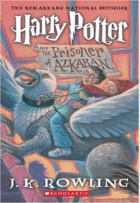
"It took a year for my new agent, Christopher, to find a publisher. Lots of them turned it down. Then, finally, in August 1996, Christopher telephoned me and told me that Bloomsbury had 'made an offer.' I could not quite believe my ears. 'You mean it's going to be published?' I asked, rather stupidly. 'It's definitely going to be published?' After I had hung up, I screamed and jumped into the air; Jessica, who was sitting in her high-chair enjoying tea, looked thoroughly scared." 8The book was an unexpected success in England, and Scholastic bought the American rights at auction. Rowling revealed that when the publicity machine cranked up, it threw her into her first-ever case of writer's block.
"Three months after British publication, my agent called me at about eight one evening to tell me there was an auction going on in New York for the book. They were up to five figures. I went cold with shock. By the time he called back at 10 p.m., it was up to six figures. At 11 p.m., my American editor, Arthur Levine, called me. The first words he said to me were: "Don't panic." He really knew what I was going through. I went to bed and couldn't sleep. On one level I was obviously delighted, but most of me froze."
"For the first time ever in my life, I got writer's block. The stakes seemed to have gone up a lot, and I attracted a lot of publicity in Britain for which I was utterly unprepared. Never in my wildest imaginings had I pictured my face in the papers -- particularly captioned, as they almost all were, with the words "penniless single mother." It is hard to be defined by the most difficult part of your life. But that aspect of the story is, thankfully, receding a little in Britain; the books are now the story, which suits me fine." 9
| "One of the nicest things about writing for children is that you don't find them deconstructing novels. Either they like it or they don't like it." --J.K. Rowling |
Jo Rowling was now successful beyond her wildest dreams. The writer's block receded into the distance and she gradually started taking control of her publicity, enforcing limits on interviews and appearances, so that she could also have a personal life. A friend introduced her to Dr. Neil Murray, a Scottish doctor, whom she married in a small ceremony with family in December, 2001. The couple's first child, a boy, was born in March 2003, just three months before the Harry Potter And The Order of the Phoenix hit the bookshelves. Their second child, daughter Mackenzie, was born in January, 2005.
Effect of Harry Potter on Popular Culture
Harry Potter has had an undeniable impact on popular culture. Before Harry Potter and the Sorcerer's Stone hit bookshelves, the children's publishing industry was in a slump. Children were beginning to spend more of their free time playing computer and video games. Television watching for children was on the rise. Suddenly, delighted parents and teachers were treated to the sight of 8 year-olds lugging around hefty tomes and actually reading them all the way through to the end. The books have been translated into all the major western european languages, but have also been translated into such languages as Turkish, Farsi, Latin and Ancient Greek. It's an unprecedented phenomenon: millions of children all over the world are reading the same books at the same time: for years at a stretch. There is a cultural touchstone that has been created, a fictional common ground that a child from Iceland and one from Scotland could both understand and relate to. While some conservative groups have complained about the deaths in the books, children seem to take it all in stride. Children know that the world is unfair: bad things happen to children every day, from divorce to illness to accidents. Sometimes those children can't talk about their own illnesses, but they can talk about Harry's tragedies, notes Rowling, remarking upon the extraordinary number of letters she's gotten from grateful parents of ill children.
Harry Potter and Religion
Jo Rowling has stated that one of the most irritating results of the books' success has been the criticism from some Christian groups that the books are un-Christian and promote the occult. Those groups infuriate the author, who is has said in interviews that she is a Christian, she believes in God and that she attends church (she belongs to the Church of Scotland, which Americans would call the Presbyterian Church). She has said that "the books aren't really all that secular," before clamming up on the subject. And, it is fun to explore some of the imagery and symbols from classical sources that Rowling has hidden throughout the text, like little Easter eggs for scholars, who do enjoy a nicely buried obscure reference. Scott Moore writes:
|
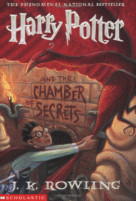
"For instance, in the second book, Harry must fight a great serpent (the historic symbol of Satan) and he realizes he cannot do this alone. In his weakness, he calls for help, and a phoenix (a Christ symbol in the Middle Ages -- the bird who dies and rises again) comes to his aid by bringing him a double-edged sword (Hebrews 4:12)."The former Archbishop of Canterbury is a fan of Harry Potter, noting in his 2001 newsletter:
"The phoenix assists Harry in his struggle. Though Harry ultimately defeats the serpent, he is badly wounded. The phoenix then comes and weeps in Harry's wounds, restoring him to health."
"By book five, we've learned that the little band of faithful believers who are united in their struggle against the dark wizard lord call themselves 'the Order of the Phoenix.' They are a symbol of the church, and we're not surprised to discover either that the powers-that-be want to root them out and destroy them or that some members must heroically sacrifice themselves for the good of the Order. Greater love hath no man than that he lay down his life for a friend." 10
"And that, believe it or not, leads me to this young man. Yes, he's made his mark in Canterbury too. Like many people, I found the Harry Potter film great fun. But like most good fantasies, it also asks some very real questions, including questions about the true source of power in our lives. At one point, young Harry is told: 'There is no good and evil. There is only power and those too weak to seek it'. Well, as Harry goes on to prove, that's nonsense." 11
| "Harry and his friends cast spells, read crystal balls, and turn themselves into animals - but they don't make contact with a supernatural world...[It's not] the kind of real-life witchcraft the Bible condemns." -- Chuck Colson, conservative Christian evangelist |
In 1999, Rowling talked to the American Library Association about the criticism that her books deal with the occult:
"If this subject offends people, that isn't what I want to do, but I don't believe in censorship for any age group, and this is what I wanted to write about. The book is really about the power of the imagination. What Harry is learning to do is to develop his full potential. Wizardry is just the analogy I use. If anyone expects it to be a book that seriously advocates learning magic, they will be disappointed. Not least because the author does not believe in magic in that way." 12In an interview with The Vancouver Sun, Rowling reaffirmed that she is a Christian, and revealed that she was starting to get impatient with those who criticize the books without even having read them. She also made a decision to stop talking about the subject so much.
|
"Yes, I am [a Christian]," she says. "Which seems to offend the religious right far worse than if I said I thought there was no God. Every time I've been asked if I believe in God, I've said yes, because I do, but no one ever really has gone any more deeply into it than that, and I have to say that does suit me, because if I talk too freely about that I think the intelligent reader, whether 10 or 60, will be able to guess what's coming in the books." 13That interesting comment by Rowling has led to at least one book by a pro-Potter evangelical Christian: Looking For God in Harry Potter by John Granger (Tynedale), a strict father and devoted student of classical literature who bought the first Harry Potter book to show his daughter why it was so evil. But when he started reading, he said he was startled to find so many classical references to the gospels and to the Christian faith. The more he read, the more he believed he has discovered the secret to what Rowling is doing: under the guise of wizarding, she is sneaking in the gospels: he believes the series is the greatest stealth Christian literature since the Narnia books. His book is a scholarly examination of each of the books, exploring the recurring themes of resurrection, the power of love over death and the fact that Harry always must ask for help from a higher power when he is most in trouble. Critics have been struck by Granger's work, although some think he is reading too much into the books.
Clearly, the millions of children and adults who have bought the books aren't terribly concerned about the controversy: as Rowling herself has said "One of the nicest things about writing for children is that you don't find them deconstructing novels. Either they like it or they don't like it." But it is a mark of the impact that the series has had on popular culture -- and on children -- that so many articles and books have been written on the subject. Many Christians who notice the issue felt it was put to rest when the Archbishop of Canterbury and the late Pope John Paul II (who looks to be well on his way to beatification as a saint) put the seal of approval on the books. Surely that should be enough reassurance for concerned parents who, frankly, should be a more focused on the fact that their child is actually reading a lengthy book about good versus evil and the choices that a young man must make in his life rather than partaking in the plethora of other, less wholesome activities that are available to today's youth.
The Place in the Pantheon
The sixth book in the series, Harry Potter and the Half-Blood Prince was published on July 16, 2005. The next film in the series, Harry Potter and the Goblet of Fire, will be released in December, 2005. Rowling is a planner. She has always known that there would be seven books, and has already begun the last book in the series, although no publication date has been set yet. So, what will she do when the last Harry Potter book is finished?
And when the seventh book is published, what then? Rowling tells Time magazine's Lev Grossman:
Somehow, that seems most unlikely."I'll be so sad to think I'll never write a Harry-Ron-Hermione sentence again," she says. But her feelings aren't entirely unmixed. "Part of me will be glad when it's over. Family life will become more normal. It will be a chance to write other things."
"We'll have to see if it's good enough to be published. I mean, that is a real concern, obviously, because the first thing I write post Harry could be absolutely dreadful, and, you know, people will buy it. So, you know, you're left with this real insecurity."
"It will be a very different kind of book," she says, "because I kind of cue up the shot at the end of six, and you're left with a very clear idea of what Harry's going to do next." "And," she adds in an uncharacteristic moment of hubris, "it will be exciting!" Then she immediately retreats into self-deprecation. "You don't know! You might read six and think, Ah, I won't bother." 14
**You can read our review of Harry Potter and the Half-Blood Prince here.
**You can find many more resources on The Harry Potter Fantastic Links Page.
Footnotes:
1 Schoenberger, Chana R. and MacDonald, Elizabeth, " The 100 Most Powerful Women." Forbes, 28 July 2005.
2 Rowling, J.K. Website Autobiography, June, 2004.
3 Rowling, J.K., "I Miss My Mother So Much." MS Matters, 2001.
4 Dunn, Elizabeth. "From the Dole to Hollywood." Electronic Telegraph, 2 August 1997.
5 Bourne, Brendan. "JK Rowling Marries Her Doctor Friend." Sunday Times of London, 30 December 2001.
6: Rowling, J.K. J.K. Rowling Website Autobiography, June, 2004.
7 Weir, Margaret. " Of Magic and Single Motherhood," Salon, 1999.
8 Ibid.
9 Id.
10: Moore, Scott. " Harry Potter Fits in Fine With Christianity" Waco Tribune-Herald. 24 July 2005
11: Carey, George, The Hon. Archbishop of Canterbury (Ret.) "Archbishop of Canterbury New Year Message." 31 January 2001
12: O'Malley, Judy: "Talking With J.K. Rowling." Book Links, July, 1999.
13 Wyman, Max. "'You can lead a fool to a book but you can't make them think': Author has frank words for the religious right," The Vancouver Sun (British Columbia), 26 October 2000.
14: Grossman, Lev, "J.K. Rowling: Hogwarts And All." Time, 17 July 2005.
More from Writers Write
Stephen King Quotes
quotes from the master
quotes from the master
Grammar Tips
improve your writing
improve your writing
Writing Prompts
spark your creativity
spark your creativity