
A Conversation With James Rollins
by Claire E. White
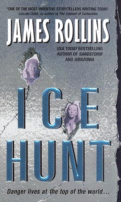
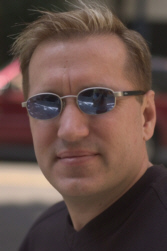 "Explore Beyond Reality" is the bold declaration at the top
of the website of New York Times bestselling author
James Rollins. It's a fitting motto for the author of
the adventure thrillers Deep Fathom, Excavation, Subterranean, Ice Hunt, Amazonia and Sandstorm.
"Explore Beyond Reality" is the bold declaration at the top
of the website of New York Times bestselling author
James Rollins. It's a fitting motto for the author of
the adventure thrillers Deep Fathom, Excavation, Subterranean, Ice Hunt, Amazonia and Sandstorm.
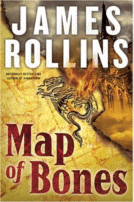
His latest book, Map of Bones (William Morrow), is a heart-pounding mix of science, adventure and mystery that hit the bestseller lists immediately. Map of Bones is the first book in the new SIGMA series, featuring an elite group of specialists with both special ops skills and scientific backgrounds who are sent all over the world to combat threats to the United States. The author describes the SIGMA team as essentially a cadre of "killer scientists…men and women who are deadlier than Bond and twice as smart."
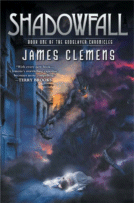
But, like one of his SIGMA operatives, Jim finds that as an author it is useful to have more than one identity. He is also known to fantasy fans as James Clemens, author of the Banned and the Banished fantasy series from Del Rey. The first book in his new epic fantasy series, The Godslayer Chronicles, entitled Shadowfall, will be published in July, 2005, by Roc.
His fantasy books have been compared to those of Guy Gavriel Kay, and there have been a spate of recent articles about his thrillers, naming him as one of the authors most likely to inherit the mantle of Dan Brown. But Jim Rollins has his own unique style: Map of Bones concerns ancient secrets and the Vatican, but the focus of the story is more the science and adventure than the art and history of The Da Vinci Code, for example. Nevertheless, there's no doubt that the two authors will appeal to readers with similar tastes.
In our previous interview, he talked about his evolution from being a successful Sacramento veterinarian to being a working writer. Now, five years later, his books regularly debut on all the bestseller lists, and his growing readership is now multinational.
In this exclusive interview, Jim discusses the truth behind Map of Bones, how growing up Catholic gives him a different viewpoint when writing a thriller set in the Vatican, and the dangers of allowing politics to trump science in the classroom.
Was there anyone in your life who particularly encouraged you in creative pursuits like writing?
|
You write quite a bit about heroes. Who were your heroes (fictional or real) when you were growing up? What, to you, makes a real-life hero in today's world?
Well, for real heroes, I think I hinted at that before, but of the fictional heroes who most influenced me, that would be a character from the pulp dime-novels of the thirties and forties: Doc Savage. Written under the pseudonym Kenneth Robeson, the novels were reprinted in paperback by Bantam books. There were 181 novels. I still have them all. Why did this particular character appeal to me? Not only was Doc the usual swashbuckling adventurer who solves mysteries and saves the world each time, but he was also a scientist. A geek who honed his mind as much as his body. And you'll see some of this same sentiment in the creation of my current series team, Sigma Force. They are a band of "killer scientists" who operate outside the rules of law...and beyond the boundaries of proven theory! It all goes back to Doc Savage.
| "I wanted to create a character who, like all of us, is faced with more than just saving the world. While saving the world is always appreciated, I also wanted to give him challenges that all of us face: family problems, romantic entanglements, old resentments, a mortgage to pay. Those stresses can be as difficult to solve as any megalomaniac with a cesium bomb." |
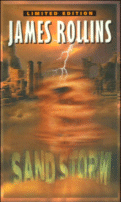
I certainly have to give my publishers credit for breaking barriers with the mass market editions of my books. With my first book, Subterranean, my publishers took a chance by developing a multiple stepback cover-the first of its kind. And once again, they're pulling out all stops and releasing Sandstorm with a new lenticular holographic cover, employing a new patented technology. Using new innovations in imaging technology, they are able to produce a 3-D image with a realistic depth and shape unseen before. And as a writer who delves into new sciences, what could be more gratifying?
Although you write series fiction in the fantasy genre, before Sandstorm you always wrote stand-alone thrillers. Sandstorm introduced readers to the elite Sigma Force and to Painter Crowe. How will the Sigma Force series work as far as recurring characters? What prompted you to take on a serial aspect to your thrillers?
For years, readers have contacted me and asked questions about various cast members from my earlier books. What became of Ashley and Ben's baby after Subterranean? What is the next port of call for the crew of the Deep Fathom? What about was incubating in the tanks at the end of Excavation?
I came to realize that I wanted to know those answers, too. I was no longer satisfied with the confines of a single book. So I challenged myself to construct a series-something unique and distinct. I wanted to build a landscape of three-dimensional characters and to create my own mythology of these people's lives. I didn't want to fashion a series like the hundreds out there already, where one character is constantly bumbling into one harrowing adventure after another, who never really ages, who never really grows.
While there certainly will be a central recurring character in the series, the supporting players will come and go in what I describe as a "revolving set of characters around a central figure." All these characters will grow over the course of the series, balancing personal lives and professional, some succeeding, some failing. The same with the central character, a new member to Sigma Force: Commander Gray Pierce. He will struggle to find his own path to balance family, God, and country, stumbling along the way, but ultimately finding his path.
Let's talk about your new book, Map of Bones, which is being compared to The Da Vinci Code, (although I understand you started the book long before The Da Vinci Code was released). What originally sparked your imagination for this story?
|
Still there is another underlying reason I decided to tell this story now. Many thrillers, when collided with the Catholic Church or the Vatican, paint the Church, faith, and belief in a disparaging light. In Map of Bones, I sought to show the Church and its past in a manner that is both realistic and acknowledges some of the Vatican's corrupted past, but also stresses the role of Church as a fundamental factor in forming Western Civilization, and how faith in all its forms is as part of human nature as our own biology, whether it be the belief in God, a Higher Power, or in the substantive good in mankind.
And yes, besides all that, it's also a nonstop wild chase around the Mediterranean through tombs, crypts, crumbling palaces, and the Seven Wonders of the Ancient World.
In Map of Bones, we meet a new Sigma team leader, Commander Gray Pierce, who is facing a difficult family situation: his father has Alzheimer's. This is a pretty serious personal complication to throw at an action hero, and the scenes Gray has with his father are quite moving. What went into your decision to give Pierce the background that you did? And will we see Pierce again?
You certainly will see Gray Pierce and Painter Crowe in the next book -- along with the return of a character from one my stand-alone thrillers (but who that is I'll leave as a mystery for now). As to Gray's family life, I wanted to create a character who, like all of us, is faced with more than just saving the world. While saving the world is always appreciated, I also wanted to give him challenges that all of us face: family problems, romantic entanglements, old resentments, a mortgage to pay. Those stresses can be as difficult to solve as any megalomaniac with a cesium bomb.
I loved the mysterious and deadly Seichan; she manages to steal every scene in which she appears. What was your inspiration for Seichan? And will we see her again?
| "Many popes have radically altered their approach to faith and dogma upon donning the mantle and miter of the papacy. I hope Pope Benedict XVI will soften his intolerant rhetoric. And anyone who loves animals must have some measure of compassion and empathy. I hope this part of his heart grows and the didactic and hard-lined rigidity softens." |
Your thrillers always have quite a few characters in leading roles, not just supporting ones. Does this present any particular challenges, as opposed to writing a thriller mostly from the point of view of only one protagonist?
My stories are full of jeopardy, with proverbial cliff-hangers around every corner. If I'm to have you care about character in jeopardy, I have to convince the reader to have empathy and sympathy for that character. The only way to achieve that is to have even the supporting characters display a rich emotional context. And in the process of doing so, supporting characters begin to develop a life of their own, growing in weight and significance throughout the novel. I wouldn't have it any other way!
The heroine of Map of Bones is Lieutenant Rachel Verona of the Carabinieri in Rome. What was the greatest challenge in creating Rachel? Were there any traits you were specifically trying to avoid with her?
I wanted Rachel to be as engaging, hard-headed, and resourceful as the "hero" of the story. So while she has vulnerabilities, she is no shrinking violet. I also wanted her to have roots and family ties as complicated as any other character. Place and character should always be intimately tied together.
Rachel's Uncle Vigor is another interesting character; there's certainly more to him than meets the eye. How much do we know about the Vatican's secret service?
|
And even today, such clandestine operations continue. During the Iraq war, the Vatican maintained detailed intelligence of conditions on the ground -- gleaned not from individual spies, but from its community of two hundred thousand Iraqi Catholics. And perhaps therein lies the Vatican's greatest strength: Between its diplomatic ambassadors, its worldwide charitable organizations, and its millions of parishioners and lay persons, the Vatican certainly maintains a sophisticated global network of eyes and ears.
What was the most challenging aspect of writing this series?
I think the most challenging part is getting all the little details right, and I don't mean just the factoids, but also those tiny foibles and nuances that enliven characters and make settings sparkle and breathe. The big plot and ideas are the easy part. The best stories only come to life in the manipulation of tiny details. Getting those right is always a challenge.
You've been doing a lot more touring and author readings it seems. Do you enjoy touring? What's the strangest thing that's happened to you on tour?
Touring itself is a weird beast. It's humbling, exhilarating, exhausting, and boring at times. But it is all worth shaking the hands of folks who have supported my stories and helped grow my readership by word-of-mouth. Plus I like to travel and to visit corners of the country where I've never been. As to weird, I was signing in a bookstore yesterday whose mascot was a hairless breed of cat (the breed is a Sphinx and the cat's name was Ripley). She was a charmer.
Many of the current political battles have at their core the longstanding friction between science and religion. Cloning of humans, cloning of pets, genetic manipulation, renewable energy, stem cell research: how these issues are decided will affect millions of people's lives. Do science and religion have to be at odds with each other? Who should be deciding the ethics issues that arise with new technologies?
|
The election of Pope Benedict XVI thrilled conservative Catholics and disturbed liberal Catholics, because of his prior rulings on hot button issues such as homosexuality, women clergy, contraception and the superiority of the Catholic religion to other religions. But this is a complex Pope who is known to love cats, and has made speeches about the immorality of mistreating animals (PETA recently wrote him a letter asking for another statement about animal rights, in fact). Do you think that Pope Benedict will be conservative in his reign? Or do you think he will moderate somewhat, especially on issues of ecumenicalism?
Many popes have radically altered their approach to faith and dogma upon donning the mantle and miter of the papacy. I hope Pope Benedict XVI will soften his intolerant rhetoric. And anyone who loves animals must have some measure of compassion and empathy. I hope this part of his heart grows and the didactic and hard-lined rigidity softens. But only time will tell.
Many schools are cutting back on science and math courses, and now there is a controversy about whether Darwinian evolution should continue to be taught to students. What are your thoughts about the place of science in our modern culture? Can fiction be a tool to get people more interested in scientific discoveries?
Most certainly. I think the best way to teach is not by dry rote, but through excitement and entertainment. I find it very disconcerting to see school systems back-sliding from scientific principles and basic education in the name of political agendas. To keep a people ignorant is to control and subjugate them. To demand blind faith and to label inquiry as disloyal is a frightening slope into totalitarianism. Freedom depends on the raised hand and the question Why. It is a responsibility of all of us...even us writers of escapist fiction.
If you were given unfettered access to all of the secret Vatican archives, where would you go and what would you look for?
The place is rich in bits of hidden history. I would especially like to read the forbidden diaries of some of the more notorious popes of the early centuries, like the Borgia pope. Then there's the Third Secret of Fatima, hidden and locked away for centuries, read only by each pope upon assuming the papacy.
Supposedly the text predicted the date the world would end. But its contents were finally revealed in 2000 by Pope John Paul II and found to be unremarkable. I still wonder if there might be more left unrevealed: I'd take a peek just to be sure. In case I need to change my retirement plans.
Please tell us about your new fantasy series, The Godslayer Chronicles.
|
If you were forced to become one of your characters from any of your books for a year, who would you be and when?
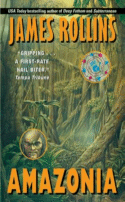
Nathan Rand from Amazonia. I love the rainforests of South America and would happily spend a year exploring those dark paths and flowing waters. Or maybe Tshui, the villainess from the same book. I always wanted to try my hand at shrinking heads.
You mentioned that you run a spay and neuter clinic on the weekends. What's your opinion of the trap, mark and release programs for feral cat populations? Is this problem getting worse in the U.S.?
It certainly is a rapidly escalating and tragic problem. I work with the Sacramento Council of Cats here in town, where we do have a whole network of volunteers who trap feral cats, bring them to the local animal shelter, where I or one of the other veterinarians spay and neuter them. We also test for Feline Leukemia and Feline Aids. Once recovered, the cats are re-released where they were trapped. Kittens and manageable adult cats are kept for adoption in a no-kill shelter. Similar programs are found in most large cities. They are all well worth supporting.
What are your pet peeves in life?
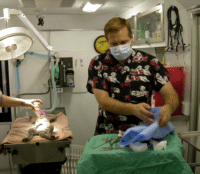 Dr. Jim in surgery. |
That the tastiest foods are the worst for you. It seems from an evolutionary standpoint chocolate should be a health food.
If you could go back in time and talk to your 16 year-old self, what would you tell him? And would you listen to yourself?
I'd tell him to never accept NO for an answer when it came to life. To parrot my mother from the first question, never accept "You can't do that." As for me heeding any advice when I was sixteen, I was too busy reading and dreaming. And besides, why should I listen to that forty-something guy over there? What does he know about life? The true answer: not much.
You can read or prior interview with Jim here.
More from Writers Write
Stephen King Quotes
quotes from the master
quotes from the master
Grammar Tips
improve your writing
improve your writing
Writing Prompts
spark your creativity
spark your creativity