
A Conversation With Kasey Michaels
by Claire E. White
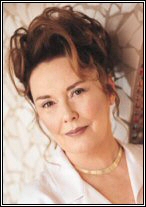
Kasey Michaels is the New York Times and USA Today bestselling author of over 85 books. She has received numerous writing awards,
|
Kasey has written Regency romances, Regency historicals, category books including novellas and continuities and a few series "launch" books, and single title contemporaries. She has coped with time travel, ghosts, trilogies, the dark side, the very light side, and just about everything in between. She is also the author of the popular Maggie Kelly mystery series, which stars a former romance writer turned historical mystery writer whose handsome and brilliant crime-solving Regency hero (and his butler sidekick) suddenly appear in her living room. This very funny series combines elements of cozy mysteries, fantasy and romance.
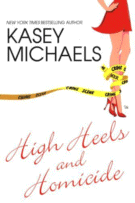
Kasey Michaels lives outside Philadelphia with her husband and four children. In this exclusive interview, she shares her inspiring story of how she got her start as a writer and discusses her bestselling new Maggie Kelly book, High Heels and Homicide. She also gives some great advice to aspiring writers.
What did you like to read when you were growing up?
Anything and everything, actually, from biographies to cereal boxes. At 13, too young for what was then the Adult section of the library, and having read almost everything in the Children's section, a librarian slipped me into the adult section and handed me Desiree, a grown up romance novel set during the Napoleonic Wars. From then on, I was taking home 8 novels every two weeks (all we were allowed to check out). I read Frank Yerby, Taylor Caldwell, Thomas Costain, Anya Seton, Ayn Rand, Mary Stewart, and on and on and on -- whatever I could get.
Did you write stories when you were growing up? What were they about, and did you let anyone read them?
|
How did you get interested in writing romance? What led up to the publication of your first book?
In 1975, my high school newspaper advisor tackled me, talked me into devoting a year to researching our township's history for the American Bicentennial in 1976. After working on that for a solid year, I was back in "writing mode," and as I'd been reading Regency novels, I decided I'd try one. What the hell, the last kid was finally potty trained -- why shouldn't I write a book and get rich and famous and all that good stuff? How hard could it be, right (I was so naive)? Goaded by a friend who volunteered to type what I'd scribbled in longhand, I actually finished an entire book and sent it off to Avon Books in New York. I had no idea what I was doing, had never taken a creative writing course, had to go to the library and walk the stacks to find a book (Writers Market) that showed how to write a query letter. I did not write a synopsis, because I had no idea how the story would go. I just started on page one, made up names as I went along, made up plot as I went along. I had a blast!
And then, bam, our 8 year-old son woke up one night, urinated blood, and the next thing we knew we were being told that I was pregnant with our fourth child on the same day we were told that our son needed a kidney transplant. For the next nine months, until our new daughter was three weeks old, I performed peritoneal dialysis on our son in the dining room of our home (where I'd sat to write my book) three days a week, six hours a day. Sometime in there I got a small, half-page piece of paper from Avon, a form rejection letter. I really didn't have time to care…
Then Michael got his transplant and I started writing down what had happened to us during those long, scary nine months. I sent off samples to editors and one told me he couldn't buy the book but did suggest two agents I might contact. Now, with an agent, that book went out again and again, and in the meantime I told the agent that I had a Regency romance stuck in a drawer -- did she want to see it? Sure. Three weeks later she phoned to tell me she'd sold it. To Avon.
That was The Belligerent Miss Boynton, and I went on to write a dozen more "alphabet ladies" for Avon. My agent also sold my nonfiction, which I'd titled after something the doctors had told us when they informed us we needed a transplant. They said we could go for dialysis, we could go for dialysis and eventual transplant, or we could let him go. The book? …Or You Can Let Him Go, under my real name, Kathryn Seidick.
Two weeks before the book came out we lost the kidney, and we had to drive from a Philadelphia hospital to New York to be on the Today show, then back to the hospital. Seven months later, another transplant. You couldn't write that as fiction and have anyone believe it plausible…
When I was pregnant and doing thrice-weekly dialysis, I stayed up all night, two nights a week, writing my second book, The Tenacious Miss Tamerlane. During our second bout with dialysis, about ten books into my career, and not pregnant, I couldn't write a word. Not one.
At different times, life hits you different ways. The one thing I learned is that you go with the flow -- it's either that or you get trampled!
How has the publishing industry changed since your first book was published?
| "I'm appalled that movies are rated pretty much on nudity and language, but nobody seems to think movie after movie with nubile young things put in the same room with an ax murderer deserve that R rating. I think parents have to know their children, know what they are mature enough to handle, and be in charge. At the same time, I think parents also need all the help they can get from the public sector -- with those warning labels to help alert us." |
I think this sex, sex, sex thing will run its course, in time, to be replaced by something else. Vampires will go away, shapeshifters will go away…and then come back in maybe 10 years. Because, in publishing, everything runs in cycles, and everything comes back, sooner or later. My writing career has made me an observer of several of these cycles over the past 26 years -- it keeps things interesting.
The problem, as I see it, is that publishing houses currently are jumping on any bandwagon that looks like it's going to be a big hit. They jump on it, and they keep jumping on it until they kill it. They ignore westerns, if that's what's "out of favor" at the moment, and go for werewolves, or whatever. Then some young editor slips a western into the list for one month, it takes off and -- bam! -- westerns, we want westerns, everybody send us westerns….until they kill westerns again. A writer just doesn't get the time to grow and develop anymore, the way we did back when I started. I think getting into publishing, and staying there, is much harder than it was when I sold my first book.
The trick for a writer who wants to be around for the long haul is to not follow the crowd, because by the time you write it, sell it, get it in print, people are up to their ears in, for instance, vampires, and you're old hat, you're just one of many -- and, hey, maybe you write a good western romance and only a so-so vampire erotica. How is this helping your career? The trick is to be ahead of the curve…..and you only do that by trusting yourself, believing in what you write, believing that others will want to read it.
The one thing you can count on the romance genre for is that it is never stagnant, it's always moving in new directions. That's half the fun!
How has what is expected of the romance author changed since you started your career?
|
We used to learn this stuff on our own, but now we have help, and editors appreciate that very much.
What is on the page is still up to the individual writer!
I'd like to talk about your latest contemporary, High Heels and Homicide. The heroine in this series, Maggie Kelly, has a unique problem: her fictional characters have come to life and appear to have taken up permanent residence in her life. What was your original inspiration for Maggie and the hero of High Heels and Homicide, Saint Just? Did Saint Just present any particular challenges for you?
One of my favorite stories, actually. I was writing a Regency historical after a contemporary, and my hero said something sarcastic to the heroine. She had to answer with something strictly Regency -- like, "That is the outside of enough!" But what I wanted her to say was, "Oh, stuff a sock in it!" And, bam, it occurred to me that, if I had a modern day writer who wrote Regency set mysteries with a continuing character who is the perfect hero, but also perfectly arrogant, as Regency heroes are, and one day he just sort of poofed into her Manhattan apartment….then she could say, "Oh, stuff a sock in it!"
So, wow. What would a Regency hero be like in modern day America? To die for gorgeous, sure. But how would he cope? Would modern, emancipated women who think he's so perfect in his arrogance and cutting wit in a Regency drawing room be as enamored of him if he left the top off the toothpaste? Questions kept piling into my head.
And that's how Maggie Kelly and the Viscount Saint Just were born.
|
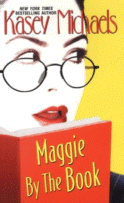
I love writing about these two, about all of the characters in these books. They grow in each book, I learn more about each of them in every book. I hope I can continue this series for a long time.
In Maggie by the Book, we learn of "Kelly's Law #3: That thing sticking in your back that looks like a knife? If you're at a writer's conference... it probably is." What was the strangest thing that ever happened to you at a writer's conference? Did you ever feel like anyone wanted to put a knife in your back (figuratively speaking, of course)?
Ah, so glad you asked that! You found that quote on the back cover of the book, right? That's because somebody at the publishing house writes that stuff, not the author. It was cute, all these "Kelly's Laws," but I asked that this particular line be changed. It wasn't. No, I never felt like anyone wanted to put a knife in my back, figuratively speaking, at a writer's conference. I've met some of my best friends at those conferences. As I said in my note at the beginning of the book, I didn't base any character on anyone -- I write fiction!
When you read a romance, what kinds of heroines do you like? Are there any characteristics that really put you off a heroine?
I like strong, intelligent heroines. I detest heroines who hop into bed with a man they swear they don't love and may think they hate. I detest when a heroine is written as a slave to her own physical desires. I like women who value themselves more than that. I want a heroine to know what she's doing, why she's doing it, and not allowing herself to be maneuvered, cajoled, or threatened by anyone. I want a heroine who puts up a good fight, who'd rather rescue herself. I want a heroine who knows what love is and will go after that love.
That said, I also want a heroine to be true to her era, the customs, morals, etc. of the time in which she lives. In other words, having a Regency Era heroine in Society jump into bed at the drop of a hat just doesn't happen in my books. Then again, my Regency Era Earls and Dukes don't take a virgin to bed just because they feel the urge. Not in a day when dancing with the same woman three times at the same ball is as good as declaring your intention to marry.
But, no matter the times, the conventions, I believe people are people, and their personalities also dictate their actions. I just want to make sure I have adequately developed those personalities on the page so that they, and their love scenes, actions, are believable -- and true to the characters.
What are your thoughts on love scenes in romance novels? Do you find love scenes more or less difficult to write than other types of scenes?
I want to make sure that a love scene is a love scene. Even if the people involved have yet to formally declare their love for each other, I need them to know in their own hearts that, yes, they do love, they do trust each other. I find love scenes difficult for one reason -- I get to adore my characters so much that sometimes it feels like an invasion of their privacy to put their physical expression of that love out there for everyone to see. Dumb, huh? So I try to put as much emotion into those scenes, as much commitment, as possible -- I do not ever want one of my love scenes to come down to -- as Maggie "said" in one of her Saint Just books -- "insert Tab A into Slot B." A good romance novel love scene is built around emotion -- not an expanded Letter To Penthouse that is really nothing but mechanical moves...at least in my opinion.
I’d like to talk about the day to day details of writing. Would you take us through a typical writing day?
| "I think this sex, sex, sex thing will run its course, in time, to be replaced by something else. Vampires will go away, shapeshifters will go away…and then come back in maybe 10 years. Because, in publishing, everything runs in cycles, and everything comes back, sooner or later. My writing career has made me an observer of several of these cycles over the past 26 years -- it keeps things interesting." |
My typical day: Up early, downstairs for orange juice that I carry back upstairs to my office (you will notice that "get dressed" is nowhere in there…
Usually I load 5 CDs into my player and play those same 5 CDs over and over and over until the book is done. Very diverse CDs, too -- chosen because I think they'll fit the different moods of that particular book. For instance, for this last Maggie, I loaded in Billy Joel, the soundtrack from Chicago, Michael Jackson, Lonestar, and Enya (yes, I am aware that I am insane!). I think I get some books done just so I can change CDs! I try for 3000 words a day. Sometimes I don't make it, sometimes I do more -- and I try to write 6 days a week. Again, sometimes I make it, sometimes I don't. The last two weeks, as I'm closing in on the end of the book, all I want to do is be at that computer, and that's all I can think about, no matter where I am. Away from the computer, I tend to have a deer in headlights look on my face and answer any question with "Uh-huh, sure ..." I'm a lot of fun -- not!
Back to how I spend my day: My husband comes in to tell me something is on CNN. Go to CNN online and check. Go back to work. Cat cries to go out. Go downstairs, put cat out on leash (don't ask…she thinks she's a dog), go back upstairs to work. Field six phone calls, none of which are necessary to anyone except the person who dared to call. Go downstairs, make lunch, drag it back upstairs with me. Work. Smile vaguely at drop-in child who thinks I'm actually listening to her. Work. Shower, supper.
In there often are: take live-in mother-in-law to one of her gadzillion doctor appointments, go with husband or child of the day to his or her many doctor appointments, go to many of my own damn doctor appointments…deal with whatever parent or child wants me to diagnose a rash over the phone, listen to the tale of the great shot my husband hit on the tenth hole -- in other words, there is no such thing as Uninterrupted Work Time in my house. If anyone has days like that, more power to them!
At the moment, for instance, I have loads of stuff due in New York. So I figured out a writing schedule, how many words I need a day, etc. Had it all planned. Then, surprise, I stepped on a stone and nearly went flying -- ended up breaking my right foot and spraining the left. I'm in a non-walking cast, hopping on the sprained foot, and using a walker. In six days, my husband gets his foot operated on and he'll be in a non-walking cast for three weeks. In other words, my schedule never seems to be a well-oiled machine. In fact, unless our daughter shows up several times a day for the next few weeks to take pity on us, we may just starve to death. But I'll be writing -- I really don't have anything else I can do!
Look ahead to the Maggie book I'll write later this year for next year. I have a feeling poor Maggie may just break her foot! Hey, don't we always hear this one: "Write what you know?"
When you start a new book, do you use outlines? How much of the story do you know before you start the actual writing?
I've changed how I do things. First book, I didn't know what I was doing each day when I sat down at the table. I still don't know exactly what I'm doing when I sit down, but I have a general idea of where I need to go.
I wrote first in longhand, read it again, added stuff. Then it was typed, with a carbon, and once that puppy was typed, no way was I changing it -- and I typed a chapter at a time, when it was read once and put aside. Then I wrote the next chapter. This made me a one-draft writer, even though I didn't know what that was at the time.
Then came the computer. Now it is easier to go back, make some changes, and I do, but I am still basically a one chapter at a time writer, and when that chapter is done -- until the read-through of the completed book -- I do not go back. I don't do drafts. I don't lay down dialogue and then go back and fill in other stuff. I don't move on with blanks in the chapter to be filled in later, facts, whatever. I don't move on until I've spelled the words correctly or looked up the facts I want in that chapter. Once and done…with, of course, a reread the next day before I start that day's new work.
Again, I didn't plan this -- it was the idea of that damn white-out and carbon paper!
I think up situations. Or, sometimes, I think up characters first, and put them into situations. I know my setup, I know the ending, and in the middle, I fudge. If I ever wrote a synopsis that stayed true into the book, my editors wouldn't know what to do…
I find names for my characters -- mostly in baby name books. When I see a name I like, for some reason that helps me define the character. I build eye color and stuff around that, begin to see the character flesh out for me.
|
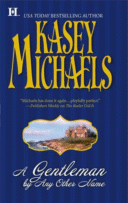
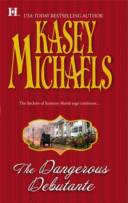
For instance: I needed a synopsis for my next Regency Era set historical. I thought of an idea...and it began to grow. And what I ended up with -- not knowing this was going to happen -- was an idea and characters for 6 connected books! HQN liked the idea, and the first three come out in three succeeding months, March, April, May of 2006. I still have three more to write, and I'm loving every minute of this -- it's as if I have a whole new other family in my life.
Oh-- the titles are A Gentleman By Any Other Name, The Dangerous Debutante, and Beware of Virtuous Women. Each book covers a year in the Regency. If anyone wants to learn more, I'll have chapter excerpts up soon.
Maggie has struggled mightily to break her cigarette habit over the years. Have you ever successfully kicked any "bad" habit (e.g., chocolate, reality TV, frappucinos, anything like that)? How did you do it?
I wish! I did actually stop drinking caffeinated Coke and switch to water and the occasional Diet Pepsi -- that was huge for me, as I used to live on caffeinated Coke. I just started drinking a little less each day, substituting water instead, and pouring half regular and half diet Coke into my glass when I just had to have a soda. Eventually, I could only drink diet soda...and now I only drink soda when we go out for dinner, and water only at home.
In case anyone is wondering, my informal research has proved that a woman who stops drinking sugared soda for diet soda and/or water loses three ounces she regains in two weeks. A man, on the other hand, who switches from soda to water, loses 15 pounds and two pants sizes in a month -- proving, once again, that life is not fair!
What amazed me with the Maggie books is that, yes, I got a million letters from readers concerned about her nicotine addiction, but her editor, Bernie was a raging alcoholic. Did I get a single letter from anyone worried about that? Nope, not a single one.
What are some of your current beauty product and/or fashion favorites?
I'm not huge on beauty products, to tell you the truth. I buy nifty miracle-promising lotions and creams, promising myself I'll develop a "beauty regimen," and then the stuff dries up in the bottles. I use Nivea Q-10 on my face because Co-enzyme Q-10 is actually something doctors agree is pretty good for us -- for heart health and good gums, something like that. I figured if the pills are good for the inside, maybe the cream is good for the outside. Very scientific, huh? Other than that, I squirt Johnson and Johnson Baby Oil all over when I step out of the shower, and then towel off. Quick, easy, cheap -- and I love the smell!
As for fashion -- I try not to go with the trends, fads, but stick to classic lines and colors that work well with each other. I wear a lot of slacks and matching jackets (mostly Chanel-type; very simple) when I'm dressed in my "writer clothes," and they are 99% of the time made of silk because I love the feel of it and the way it moves, hides bumps, and it even packs beautifully. I'm a blacks and earth tones sort of person -- look terrible in pastels. I think I last bought a dress when I bought a gown for my youngest's wedding. I am a slacks person.
At home, I stay in my pajamas on writing days until it's time to shower and prepare or (mostly) go up the street to the local restaurant for dinner. Then it's jeans and sweaters or shorts and t-shirts. Or, as people tend to say when they meet me: "Funny -- you don't LOOK like a writer."
Although your books have lots of romance and humor, as well, they also touch on some more serious issues, such as class differences, trust and love. Do you tend to think in themes when you write?
I keep getting asked if there's a common thread, a recurring theme, whatever…and I keep wondering, hmmm, is there? The only thing I can come up with is that I am a firm believer in trust. That without trust, there's no foundation to build anything on -- a life, a love. If you read any of my books, you will notice one thing that's the same in each of them -- nobody, and I mean nobody, hops into bed until there is trust. Not necessarily an oral declaration of love, but they damn well believe in each other. I guess I never understood how people could be physically intimate, and still too nervous about getting "too personal" in asking if the person loves them. Say what? You're naked with this person -- and you can't talk to him/her? Yeah, that would be the common thread, I guess: my people have to love and trust each other, and know it!
One of your trademarks is very funny and witty dialogue. How did you learn to write dialogue?
I would have to say I learned by reading good books, watching good tv shows and even listening to good songs, plus listening to people when they speak. Some people have an ear for music -- mine seems to be for dialogue, even that elusive "comedic timing." I can hear the "bum...bum" beat before the character delivers the punch line. As I write, I can hear the dialogue in my head -- the nuances, the pauses, all of it. I try not to question things like this -- or I might not be able to do them again, so I'm just glad that I like to write dialogue.
Now, description? Telling the reader what the sky looks like, how the house sits on the hill? Forget it -- not my forte! So it all evens out...
As a mother, how concerned are you about the amount of violence and/or sex in videogames, television and movies?
Very! I was a stay at home mom and could monitor what my kids watched, played, listened to. A lot of moms don't have that luxury anymore. There are those V-chips on TVs, and warnings on video games and music -- but even a stay at home mom can't go to the neighbor's house with her kid and monitor what he sees, hears there. It's tough, and getting tougher.
I'm not thrilled with the amount of sex on afternoon soap operas...or hearing how many kids watch them. I'm appalled that movies are rated pretty much on nudity and language, but nobody seems to think movie after movie with nubile young things put in the same room with an ax murderer deserve that R rating.
I think parents have to know their children, know what they are mature enough to handle, and be in charge. At the same time, I think parents also need all the help they can get from the public sector -- with those warning labels to help alert us.
What are your pet peeves in life?
Sounds and smells come to mind first: popping gum, loud chewing of food (especially with the mouth open -- why do moviemakers think we like to hear/see this?), perfume poured on by the gallon.
What do you love most about being an author? What is your least favorite aspect of the profession?
|
Like least: Having to promote my own books. I write it, I shouldn't have to hawk it -- that's the publisher's job. I'm waiting until I'm #1 on The New York Times list (ha!), and then the publisher will buy me more promotion and publicity than I'd ever need again. But that's just the way it works…
One of the greatest challenges facing women today is trying to accomplish more than ever in a limited amount of time, and having to play many roles in life: businesswoman, mother, wife and friend. You are so prolific in your writing, yet have also managed to have a full and satisfying family life as well. How do you juggle all the demands on your time? Do you set certain priorities in your life?
Last question first: Yes, I have priorities. They change, however, depending on the moment, the need. When our son was ill, he came first, above everything, everyone. This was explained to our other children, and they knew if they ever needed to be #1 they would be. Living the life we led when he was sick, we learned that you do "what comes next." When that's done, you do the next thing, and then the next. Start with the most important, and then go from there -- which often meant that dinner came from a fast food restaurant and the laundry piled up next to the washing machine, because sometimes the top priority was sitting down playing a game with the kids.
Now, with deadlines, I have to keep those deadlines very near the top of my list -- after all, I made a promise and I have a responsibility to live up to those promises, those deadlines. But life, in the form of accidents, illnesses, deaths -- well, life interferes, and then you have to juggle. We all do. I think we all just do "what comes next."
Some of my friends, and my family, wonder "how do you do it?" The answer is easy: it's there, it has to be done, whether it's caring for a sick child or writing a book -- or anything in between. My favorite quote of all time is from John F. Kennedy when he was asked how he became a war hero. His answer: "It was involuntary -- they sank my boat."
Nobody sets out to be a hero, be Superman, do the impossible, maybe more than once. Sooner or later, though, most of us end up "involuntary heroes." Because the alternative is to cut and run, and who wants to do that?
You have written in a number of genres, from mystery to historical romance. Of all the genres, romance (quite unfairly) gets the most criticism as a valid art form from "literary" critics, even though it is the most popular genre of books sold in America. Why do you think this is true? Does the fact that it is mostly women who buy romances have anything to do with it?
Hey, we deserve some of our lumps. We do some dumb things, chase a few trends that make us look a little ... well, a little wacky. So do other genres, mystery, thriller, fantasy, etc, etc -- no genre is better or worse than the other; we're all writing "popular fiction." But those other genres aren't out there banging a drum saying "Look at us! We're X percent of the market! We have college professors writing these books! You're only being nasty because we're women! We demand respect!" On and on and on. Oh, pshaw! Face it, we're not writing War and Peace -- we're writing love stories. And that's good, that's even great. But banging that "respect me" drum? It's like we set ourselves up for that punch to the jaw.
I love what I do. I entertain. If that bothers some people, hey, that's their problem. I'm not going to defend what I do or the readers who buy my books. Why should I? We know who we are, we know what we like -- and the day the opinion of some yahoo who doesn't read romances or is stuck doing a Valentine's Day interview when he really wants to be covering the police beat or something else "important" so all he can think to do is write cliches and phrases like "bodice rippers" and "purple prose" -- well, the day I worry about these people is the day I should hang it up and do something else. I will not attempt to defend what I do to someone who only wants a juicy quote, and I have no control over what other authors write. We each write our own books -- and Suzy Writer shouldn't have to defend my books, and I shouldn't have to defend hers. Sometimes I think some authors believe we're just gals in the same club or something, and we're not -- we're individual writers, responsible for ourselves and our own work, period.
Maybe if we stopped worrying so much what other people think, these "other people" would find someone else to pick on and just let us all, writers and readers both, enjoy ourselves. I didn't always feel this way, this mellow. But I've been around for a long time now, listening to the same jabs and jokes for twenty-six years, and being angry with people who refuse to listen is an exhausting emotion. Why bother?
What's your idea of the perfect romantic getaway weekend?
Oh, I'm bad...because for my husband and myself, the perfect romantic getaway weekend is at our favorite casino in Atlantic City, where we eat well, relax, visit the spa...and I have a minor love affair with the nickel slot machines. A two hour car ride is about all the "travel hassle" I want to face anymore...
What is your advice to aspiring novelists?
| "Write to your schedule, not anyone else's. Write with the tools you like. It doesn't matter how Kasey Michaels faces her writing day -- unless you want a giggle, that is. You are you, you are not anyone else, and that's great. Run, run fast, when anyone (except your editor or agent, of course) says anything concerning your own personal creativity that begins with "You must do…." |
I've learned -- from observation -- that having too many cooks spoils any broth…and a lot of books. Enter six contests with your manuscript, get six different opinions, lock yourself in a dark room and weep. Why do people torture themselves like that? Trust your own instincts, possibly one very good friend, and write your book. An entire committee and a bunch of judges won't be there holding your hand for Book Two -- so learn how to do it on your own from the get-go. I know that flies in the face of everyone who swears they would never have gotten published without their critique group or six contest entries -- but how do you know that if you haven't tried it?
Other writers laboring at the same level of their careers are great to know, nothing's better than a great writer's organization for finally meeting people who operate on your same wavelength (because it's true -- writers are "different"). Commiserate about the hours you work, your last rejection letter, brainstorm together, learn how to write a query letter, exchange stories about agents and editors, on and on and on -- but in the end, we all must write our own books.
Sure, listen to published authors who speak about these things -- hell, I do "first page" workshops and I do think they help -- but don't rely on anything anyone else says unless you truly believe that person is right! Writing for yourself is the only way to write from the heart -- the day it becomes "how did they say I should I do this?" instead of "I can't wait to do this!" you're in trouble!
Write to your schedule, not anyone else's. Write with the tools you like. It doesn't matter how Kasey Michaels faces her writing day -- unless you want a giggle, that is. You are you, you are not anyone else, and that's great. Run, run fast, when anyone (except your editor or agent, of course) says anything concerning your own personal creativity that begins with "You must do…."
I regret ever falling for the "you must do it this way" workshops early in my association with writer's groups, I felt like a failure because I had a two-book contract instead of a five-book contract, etc. Never look at someone else's career and wish for it, envy it, try to emulate it. You are you, so do it your way and know that it's your way. Nobody is ever happy in someone else's skin. You'll enjoy your writing groups, conferences, etc, much better, I promise!
Have fun with your writing, your life. There is no second time around. This is it. Enjoy the moment, whatever moment you're in!
And believe in yourself. Always.
More from Writers Write
Stephen King Quotes
quotes from the master
quotes from the master
Grammar Tips
improve your writing
improve your writing
Writing Prompts
spark your creativity
spark your creativity