
A Conversation With Marjorie M. Liu
by Claire E. White
She is only 26, but Marjorie M. Liu, is already making her mark in the publishng world. Five years after graduating from Lawrence University
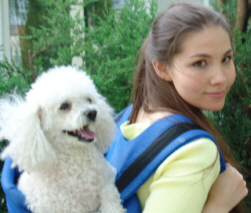 Marjorie M. Liu and her poodle Daisy. |
She knew that she wanted to write books for a living, and had successfully published poetry, short stories, and non-fiction pieces. But she had never finished a book-length piece and knew that it was time to make her dream a reality. So she took time off, and wrote nearly non-stop for one month. She submitted the manuscript for Tiger Eye herself to several publishers, going through the slush pile. The editors at Dorchester loved what they saw and promptly offered her a contract for Tiger Eye, a powerful and magical adventure story set in China and the United States. Tiger Eye opens at the Dirt Market in Beijing where a young American sculptor is enjoying haggling for treasures. When an old woman sells her an ancient riddle box for one Yuan, Delilah's life takes a major turn. Inside the box is a bespelled 2,000 year-old warrior who must serve whoever owns the box -- and he's not happy about it. Hari and Delilah must band together to solve the mystery of the riddle box while fighting off an ancient evil Magi and the modern day Chinese mafia. Publisher's Weekly brands Tiger Eye "a first-rate debut" and Booklist notes that "this is the next book fans of Sherrilyn Kenyon or Christine Feehan should read." Her writing is vivid, imaginative and laced with wit and sensuality. The buzz on her first book spread like wildfire though the reviewing community, and it's clear that Marjorie has great things in her future.
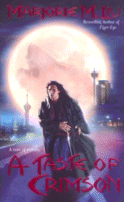
In addition to the sequel to Tiger Eye, Marjorie is also writing the second book in the awaited Crimson City urban fantasy series, entitled A Taste of Crimson which is due out in August, 2005, after Liz Maverick's series opener, Crimson City. And in January, 2006, Marjorie's X-Men novel, The Outcast Empire, will be released.
When she's not doing book proposals or writing, you might find her working on her X-Men Wolverine website, catching an episode of Alias, Stargate SG-1 or Lost, or blogging about writing. Marjorie talked to us about her move from lawyer to novelist, and how she turned her writing dream into reality. She also talks about her new X-Men project and how fan fiction helped her get where she is today.
When you were growing up, what did you want to be?
So much. Astronaut, Egyptologist, archeologist (namely, Indiana Jones), starship pilot, doctor, folklorist, a female Magnum P.I., race car driver, the human sidekick to Optimus Prime, a Jedi Knight...you know, regular stuff. Which is why being a writer makes perfect sense. I get to be all of those things and more. Kind of.
What did you like to read when you were growing up? How did you get interested in Fantasy/SF? Romance?
|
I think my love of Fantasy and Science Fiction was just a natural extension of having a big imagination. I could so very readily accept the fantastic because I was already imagining those things for myself. And besides, there is something truly wonderful about living a life in which looking at the world becomes so much more than just a matter of accepting "reality." That's what good books do. They expand your vision. As far as romance goes, the stories I've enjoyed have always had an element of the romantic -- subtle or not.
What originally compelled you to apply to law school? What about the life of a lawyer disillusioned you later?
I majored in East Asian Languages, with a minor in Biomedical Ethics. Not many jobs for people with a degree like that. So I thought about law. Applied, got in, and surprisingly enough, found a lot of opportunities to use my undergraduate degree. The University of Wisconsin law school has a great East Asian legal center, and some of the country's top experts in Biotech Law are on the faculty. On my own, I found an internship in Beijing working at the Foreign Agriculture Service at the US Embassy. At the time, FAS was dealing with the Chinese government's new rules regarding the import of genetically modified food -- and it was fabulous. A perfect learning environment that I will never forget. The people there were great, too.
So law school was wonderful -- if I could, I would go back again. Being a lawyer, however, was a completely different story. I think my defining moment was before I even graduated. I was taking a class on business law -- an interactive course, where we split up into teams and negotiated business deals for large multi-miliion dollar corporations. All pretend, of course -- but almost everyone in that class went through a radical personality shift -- myself, included. I became a mean person. Really mean. Like, outright nasty. Now, I'm no Pollyanna, and I've never touted myself as some sweet doe-eyed pussycat -- but I shocked myself. I didn't like it, either. I realized after that experience that given enough time and enough opportunity, that was who I could become. Ten or twenty years down the line, I would be the person I used to hate. An asshole. So I was already disillusioned when I graduated. Very much so.
Some authors despise fan fiction; others have no problem with it at all. What are your thoughts about fan fiction? What prompted you to create the wolverineandjubilee.com website? Now that you are an author with an established universe, how would you feel if fans start writing in your universe?
| "Read first, then write. Read many different kinds of things. Do not censor yourself, ever. Be wary of asking other people to read your work -- sometimes it is very necessary, but you have to choose carefully. You want a person who can be your editor. You do not want a person who edits you." |
And I got drawn in. Big time. So much, that I actually began writing my own fan-fiction. This was not something I ever envisioned myself doing, but what was amazing was how cathartic it was. I had been writing original fiction and poetry since I was tiny, but with fan-fiction, I could post it on the internet and no one knew who I was. It was purely anonymous. I wasn't being judged, or graded, or hemmed in -- and wow, what a freeing experience. So in that sense, it helped my skills as a storyteller because I was able to experiment with different styles and ways of writing, without fear of retribution. You know, the kind you get in English class when the teacher says, "Well, you just can't do that."
So if someone wants to write about the characters in my universe? I am flattered. I think it is a huge compliment, and I wish you the best time of your life while you're doing it. I also hope you learn something about writing along the way. Just don't ask me to read it! I don't want to be accused of stealing anyone's ideas!
Please tell us about your road to publication. I understand you sent in your manuscript unagented?
Oh, yes. I did query agents, and one responded -- but she found the first three chapters too unbelievable and passed. I figured the same would happen with every other agent (and it did), so I began sending out the manuscript to all the big houses that took unagented material. Slush pile city. Dorchester was the only one that liked what I had to say. Chris Keeslar contacted me the day before my twenty-sixth birthday -- which was less than a year ago. My life has changed drastically since then -- for the better.
I'd like to talk about your new book, Tiger Eye. What was your starting point for this story?

|
The opening of the story is set in the Dirt Market in Beijing. What was your first visit to Beijing like? What stands out in your mind? What did you buy at the market?
My parents were transferred to Beijing by the company my dad worked for, so my first visit was really a house-hunting trip. What struck me at the time was how wild and modern everything was -- and yet, everywhere I walked, there was this undercurrent of great age. You can taste the history in Beijing. It is a beautiful city. Beautiful on an old-soul level that just...draws you in. To be honest, everything stands out to me. Every day I could walk those streets and see a hundred stories -- all of them, perhaps, in a man's face. It's incredible.
As far as Pan Jia Yuan goes (the Dirt Market), it was so much fun! I love to bargain, and there's nothing quite like doing it in the native language. On my first visit, I remember that I bought a tiny stone jewelry box (no relation to the riddle box of Tiger Eye), and these lovely antique hair pins that had butterflies and dragons on them. Now that was the haggle of a lifetime. The older woman who sold them to me wanted way too much money -- and I was way too stubborn -- but we had such a good time yakking at each other that it stopped being about the price after the first minute. In the end, I did get the clips...and then she talked me into buying a couple more, so she made back everything in the end. Ha!
The hero of Tiger Eye is Hari, ancient immortal warrior who has many preconceived ideas about his newest master. What was the most challenging aspect of writing Hari? Were there any traits you were particularly trying to avoid with him?
That's a hard question. Sometimes I wonder if I could have done a better job with Hari -- as in, exploring some of his hang-ups, making him more of a flawed person. Because hey, if I had been locked up for 2000 years, I would be a total wack job. The truth, however, is that when I wrote the story, my hope was to show how incredible strength of character and incredible stubbornness can be enough to carry a person through any hardship. As it does Hari. Traits to avoid were arrogance, smugness, the sense that "I'm God's gift to women." Those things turn me off in real life, so I'm not going to write them into my heroes.
The heroine is Dela, a very interesting woman who has some unusual talents. How did you create Dela?
She was just born on the page. I collect knives, so that was probably a specific outside influence, but everything else was very natural. Well, okay -- I had been to China, too -- but everything after that!
What are your thoughts on writing love scenes? Do you find them more or less challenging than action scenes?
| "[Blogging] doesn't get my creative juices flowing, but it's not a distraction, either. I hesitate to call it free therapy, because I'm a very private person -- what I write is the stuff that I don't mind people knowing about me. I suppose my ultimate goal is to make my journal a place where people can read about what it means to be a writer....that's what I'd like to accomplish: create a resource for people who need realistic information and reassurance that yes, writing is possible." |
I'd like to talk about the actual creative process. Would you take us through a typical writing day for you?
It has varied from book to book. Seriously. When I wrote Tiger Eye, I would get up at 6 am and work (with some breaks) until 3 am. I did this every day for a month. I listened to a lot of music, which crossed the range from Alternative to Classical, and I kept a pile of post-it notes in front of me. Every time I ran into an inconsistency or problem, I'd jot something down and stick it to the surface of the desk. Those came in very handy during revisions, most of which took place in the coffee shop at the local Barnes and Noble. I printed out the entire book and just lugged it around with me.
A Taste of Crimson, on the other hand, had a much more varied pace because I was moving at the time and living in hotels and helping fix up an old farmhouse. Towards the end I hit my stride again in the 6 am to 3 am range, but for most of that book, I was only getting in about four to five hours a day. Which feels slow.
Honestly, though, I can write almost anywhere, with almost any kind of background noise. It's just a matter of settling into my groove.
What was your first book signing like? Were you nervous beforehand?
Yes, very. My mom took some pictures of me at the signing that will never ever be shared, because you can see the pure panic setting in. And then, after the first ten minutes, it completely went away. Cool as a cucumber. I actually ended up enjoying myself.
What was the experience of the Clarion Science Fiction Writers' Workshop like? How was it helpful to you as a writer?
Clarion was wonderful. I had never been immersed in an environment that was so conducive to writing, where everyone understood and appreciated the desire to be a writer. It was such a rare thing to be given, that kind of time and experience, and I was lucky -- we all were -- because as a group, we all got along. We liked each other. I made friends for life. And the teachers! The teachers were fantastic. Where else can you be taught by such talent as Jeff Ford or Kelly Link, or Nina Kiri Hoffman and Andy Duncan? Suzy Charnas was there! Nancy Kress! Gordon Van Gelder! I learned so much about craft and style -- including my major weak points in those areas -- and I learned it fast because there was no alternative. I had to keep writing, submitting, and you learn quickly about your problem areas when you do that because there isn't any time to edit. You see, up front, the mistakes you always make. And that's a good thing.
What has surprised you most since you got published?
How much organization is required when one writes on an expedited schedule. There is a lot to keep track of -- a lot to do, too -- and if you aren't careful, things can really pile up.
What are your next book projects?
| "[B]eing who you are is the privilege of a lifetime, and even when times are bad, that never changes. You are alive, which means life is full of possibility. Bad things happen, but in the next breath something good can fall into your lap....[T]he instant you tell yourself, however faintly, that it is over, you block the possibility of goodness -- you block your potential." |
What are your thoughts on blogging? Do you find it to be a distraction from your writing, or does it help get the creative juices flowing? Or is like a free (public) therapy session?
It doesn't get my creative juices flowing, but it's not a distraction, either. I hesitate to call it free therapy, because I'm a very private person -- what I write is the stuff that I don't mind people knowing about me. I suppose my ultimate goal is to make my journal a place where people can read about what it means to be a writer -- sort of like what Holly Lisle has done with her journal, which is always fascinating and inspiring, because she is such a hard worker. Down the line, that's what I'd like to accomplish: create a resource for people who need realistic information and reassurance that yes, writing is possible.
Let's talk about your upcoming X-Men book, The Outcast Empire. How did that project come about? How does it feel to be writing in the X-Men universe?
So. Very. Cool. The project came about over lunch with my agent, Lucienne Diver. I mentioned that one of my dreams was to write something for Marvel, and she happened to know an editor who was looking for authors to do just that. So I put together some proposals and over the next six months we went back and forth until Marvel approved one of my ideas. The rest is history. I'll be starting that book in just a couple of days. I'm very excited.
If you could go back in time to talk to your 16 year-old self, what would you tell her?
Ha! Follow your instincts. Do not follow the crowd. Stay stubborn. Dream big. Be happy. Have goodness in your heart. It will all work out in the end.
What are your favorite guilty pleasures, as far as TV, movies, and snack foods go?
Stargate! The Amazing Race! Lost! Grapes! Chocolate truffles! I love action movies of any kind, as well as good old Romances.
What are your pet peeves in life?
Ignorance, which can take so many different forms. Holier-than-thou attitudes. People who won't get their hands dirty when a job needs to be done. I could go on, but when people complain too much, they inevitably begin touching on the same areas they themselves are guilty of.
What is your advice to aspiring writers?
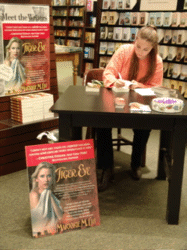 Marjorie M. Liu at a booksigning for Tiger Eye. |
You describe yourself as an optimist. How do you keep yourself motivated when things aren't going so well in life?
Because being who you are is the privilege of a lifetime, and even when times are bad, that never changes. You are alive, which means life is full of possibility. Bad things happen, but in the next breath something good can fall into your lap. The moment you give up, though -- the instant you tell yourself, however faintly, that it is over, you block the possibility of goodness -- you block your potential. That's so horrible. Living a wasted life? Existing in a state of disbelief, telling yourself that the world has nothing to offer you -- or worse, that you have nothing to offer the world? What a lie. What a terrible self-deceit. It is so unnecessary. Believing in better things -- being an optimist -- is so much more fulfilling.
More from Writers Write
Stephen King Quotes
quotes from the master
quotes from the master
Grammar Tips
improve your writing
improve your writing
Writing Prompts
spark your creativity
spark your creativity